
15 Sep When Water Will Not Wait: TheDryAir Dehumidifiers Built for Serious Restoration Jobs
A burst pipe, flooded basement or serious leak has a habit of turning an ordinary room into a restoration project remarkably quickly. Removing visible water is only the beginning because moisture can remain in the air, flooring and building materials long after the puddles disappear. That is where commercial drying equipment earns its place. TheDryAir offers a dedicated collection of AlorAir water damage restoration dehumidifiers built for demanding moisture-removal jobs, with capacities ranging from more compact commercial units to high-output machines for larger spaces. Features across the range include built-in condensate pumps, automatic operation, LGR or SLGR technology and, on selected models, smart Wi-Fi control. For restoration professionals and property owners dealing with substantial moisture, these are machines designed for considerably more than making a slightly humid room feel nicer.
Water Damage Restoration Needs More Muscle Than Everyday Humidity
A domestic dehumidifier can be perfectly useful for ordinary household humidity, but restoration work creates a much heavier moisture load. The commercial models available from TheDryAir are designed around applications such as flood cleanup, water damage restoration and persistently damp commercial environments. Choosing the correct capacity depends on factors including room size, ceiling height, humidity, airflow and the amount of moisture present. TheDryAir’s guidance suggests roughly 50 to 60 PPD for spaces up to 1,300 square feet under standard conditions, rising to 160 PPD or multiple machines for areas above 3,800 square feet. Restoration conditions can require additional capacity, however, so square footage should be treated as a starting point rather than the only number that matters.
LGR and SLGR Technology Step In When Conditions Get Tough

For demanding restoration work, TheDryAir offers AlorAir machines using LGR and SLGR technology, which are designed to maintain effective moisture removal in challenging restoration environments. This becomes particularly relevant when humidity is high or temperatures are lower, conditions where simply running a basic dehumidifier may not provide the drying performance a job requires. The collection includes options such as the Storm LGR Extreme, Storm SLGR 850X and larger Storm models, giving buyers different capacities rather than one oversized solution for every property. That distinction matters for restoration businesses because portability, job size and drying targets can be just as important as headline extraction figures. More capacity can accelerate demanding work, but unnecessarily oversized equipment may simply add cost and bulk to smaller jobs.
Built-In Pumps Keep the Water Moving Without Babysitting the Machine
Extracting moisture is useful only if the resulting water has somewhere sensible to go. Many commercial restoration dehumidifiers sold through TheDryAir feature built-in condensate pumps and drainage arrangements, reducing dependence on repeatedly emptying a reservoir during extended drying jobs. That is a practical advantage on restoration sites where equipment may need to operate for long periods while technicians manage several areas at once. Automatic operation and shutdown features on selected units add another layer of convenience. This does not make restoration completely hands-off, since humidity levels, drainage and equipment performance still need appropriate monitoring, but it can reduce unnecessary intervention. On a job where flooring, walls, furniture and irritated property owners already require attention, not having to constantly check a tiny water bucket feels like one problem happily removed from the list.
Wi-Fi Control Makes Multi-Site Restoration Less of a Guessing Game
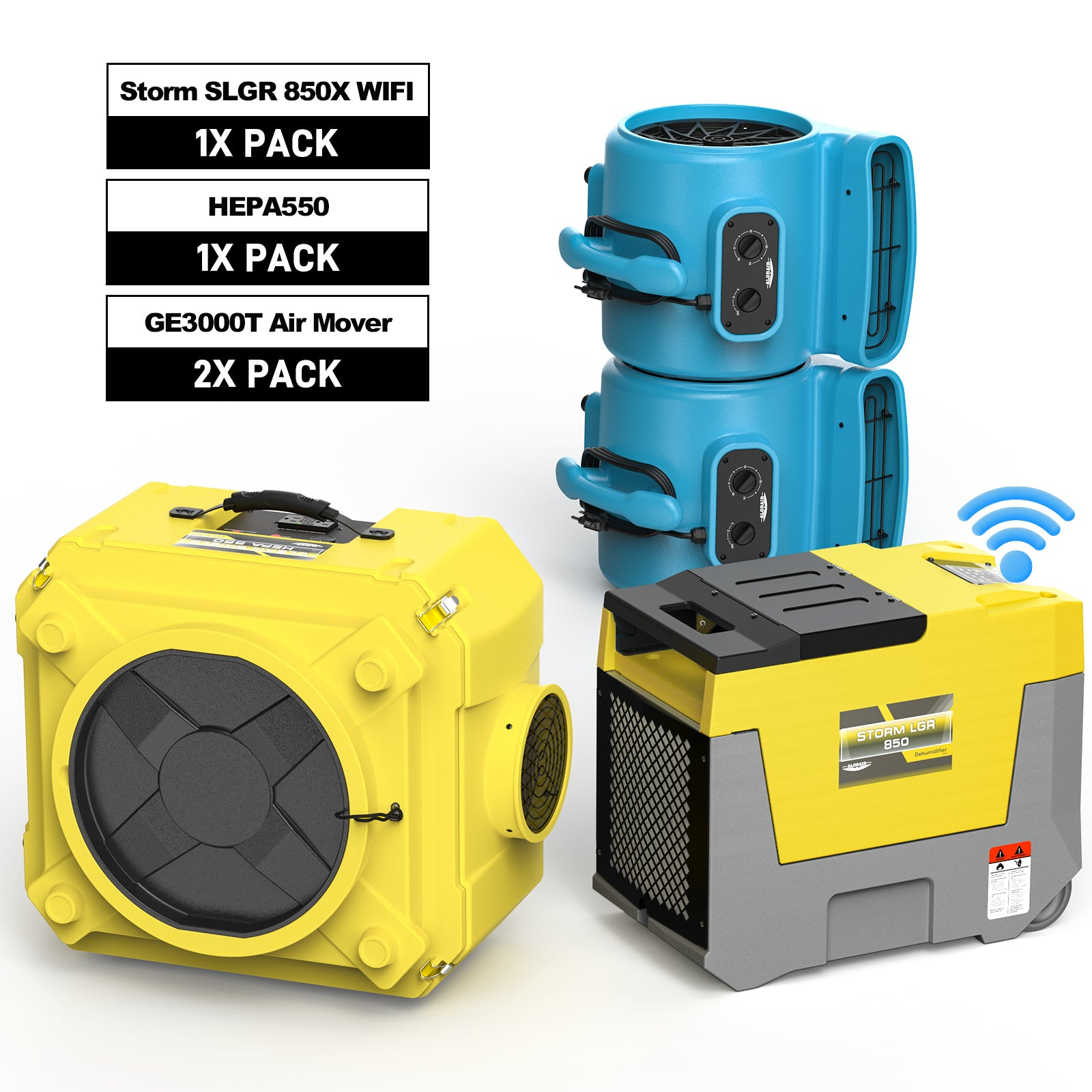
Selected AlorAir models available from TheDryAir add Wi-Fi and Bluetooth connectivity through the AlorAir-Lite app, allowing compatible dehumidifiers to be monitored and adjusted remotely. For a homeowner drying one basement, that may simply be convenient. For restoration professionals moving between multiple jobs, remote visibility has considerably more value because equipment conditions can be checked without treating every adjustment as another site visit. Models such as the Storm SLGR 850X incorporate smart connectivity alongside commercial moisture-removal capability. Technology should not replace physical inspections or professional moisture assessment, particularly when structural materials have been affected, but remote controls can make equipment management more efficient. Think of it less as letting your phone fix water damage and more as giving it something genuinely useful to do for once.
Dehumidifiers Work Better as Part of a Drying Team
One of the most useful aspects of the TheDryAir restoration range is the recognition that a dehumidifier is often only one part of the drying process. The retailer also offers restoration packages combining commercial dehumidifiers with air movers and HEPA air scrubbers. Each tool has a different role: dehumidifiers extract moisture, air movers increase airflow across wet surfaces, and air scrubbers can help manage airborne particles during appropriate restoration work. Packages range from relatively focused setups with one dehumidifier and a couple of air movers to larger combinations intended for more substantial jobs. That makes bundled equipment particularly interesting for restoration companies building a professional kit, although occasional users should consider whether purchasing an entire system makes financial sense compared with selecting only the equipment their situation requires.
Storm 80X or Storm Elite Comes Down to the Scale of the Job

The range at TheDryAir covers noticeably different output levels, which makes comparison more useful than automatically choosing the largest machine. For example, the Storm 80X is positioned as a portable commercial restoration dehumidifier, while the Storm Elite targets larger spaces with substantially greater maximum moisture-removal capability. Between those extremes are models such as the Storm LGR Extreme and Storm SLGR 850X, giving professionals room to match equipment to typical projects. Smaller machines can be easier to transport and position in tighter spaces, while higher-capacity units make more sense when drying large areas or handling heavier moisture loads. Buyers should compare rated performance under the same testing conditions and remember that actual extraction changes with temperature and humidity. The biggest number on the product page is useful, but context is considerably more useful.
TheDryAir Is Best for Buyers Who Need Restoration Equipment, Not a Bedroom Gadget
The water damage restoration collection from TheDryAir makes the strongest case for restoration contractors, property managers and buyers dealing with moisture problems beyond ordinary household humidity. The choice of AlorAir LGR and SLGR machines provides options across different capacities, while built-in pumps, smart controls on selected models and access to air-mover and air-scrubber packages create room for more complete drying setups. Smaller commercial units suit jobs where portability matters, while higher-output models are easier to justify for larger restoration projects and frequent professional use. No dehumidifier removes the need to identify and repair the original source of water, and serious flooding or structural damage may require professional assessment. Once that problem is under control, however, having equipment matched to the drying job can make the road back to a dry property considerably more organised.

Sorry, the comment form is closed at this time.